Choosing the right industrial flooring requires balancing long-term value with daily performance. Although often overlooked, commercial concrete staining can be a good choice, offering a durable, budget-friendly solution for the right environment.
This article evaluates concrete staining as a strategic business investment, comparing it to other commercial flooring options to help facilities make informed, long-term decisions.
Is It Better to Stain Concrete or Paint Concrete?
For commercial and industrial facilities, the choice between staining and painting concrete floors should be based on performance, durability, and long-term maintenance costs, not appearance alone.
Concrete Paint vs. Concrete Staining
| Pros | Cons | |
| Concrete Paint |
|
|
| Concrete Staining |
|
|
The Business Impact: What this Means for Facilities
From a business perspective, painted concrete shifts costs forward. While the initial investment is lower, facilities often face recurring maintenance, unplanned downtime, and ongoing disruption as coatings fail under traffic, cleaning, or moisture pressure.
Concrete staining, by contrast, reduces long-term operational risk. Because it becomes part of the slab rather than a surface layer, staining minimizes failure points, lowers maintenance frequency, and helps extend the usable life of existing floors. Wear appears gradual rather than damaged, allowing facilities to plan maintenance instead of reacting to it.
Bottom line: For managers focused on uptime, predictability, and total cost of ownership, concrete staining is typically the more strategic and cost-effective choice over the life of the facility.
Is It Better to Polish Concrete or Coat Concrete?
For commercial and industrial facilities, choosing between polished concrete vs. floor coatings depends on how the space is used, the level of protection required, and long-term maintenance expectations.
Polished Concrete vs. Concrete Floor Coatings
| Pros | Cons | |
| Polished Concrete |
|
|
| Concrete Floor Coating |
|
|
The Business Impact: What this Means for Facilities
From a business perspective, polished concrete offers predictable durability with minimal ongoing maintenance, making it a strong investment for high-traffic environments where uptime and consistency matter most. With no topical layer to fail, facilities avoid the recurring costs and disruptions associated with recoating.
Concrete floor coatings, while typically requiring more maintenance over time, deliver critical protection in demanding industrial settings. For facilities exposed to chemicals, moisture, impact, or strict safety requirements, coatings reduce operational risk by providing performance characteristics that polished concrete cannot.
Bottom line: Polished concrete is often the better long-term investment for facilities focused on durability and low maintenance, while coatings are the strategic choice when specialized protection and performance are essential to operations.
What Colors Are Best for Staining Concrete?
For commercial and industrial facilities, the best concrete stain colors are those that hold up visually over time and minimize maintenance concerns.
Most facilities select:
- Neutral earth tones (tan, beige, light brown) for a clean, professional look and resale flexibility.
- Grays and charcoals to better conceal dust, wear, and traffic patterns.
- Subtle combination finishes to help blend existing slab imperfections without appearing decorative.
Different colors can be applied in geometric patterns or with the use of detailed stencils. Some contractors can even use skilled hand techniques and a second stain to create marbling or even bolder patterns.
From a business standpoint, these colors age well, require less visual upkeep, and support long-term value.
Stained Concrete Colors in Real Applications 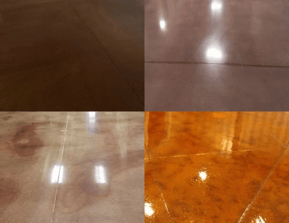
This photo represents some of the color and pattern combinations we've done for recent clients.
- The two top photos represent a solidly applied single color for a rich finish.
- The photo in the bottom left is from a school classroom and features a hand-applied, free-form design.
- The floor on the bottom right features a smaller pattern.
How Much Does It Cost to Stain Concrete?
The cost to stain concrete in a commercial or industrial facility depends primarily on the condition of the existing slab and the level of surface preparation required. Because concrete staining penetrates the concrete rather than creating a surface coating, it is often positioned as a cost-effective option for facilities looking to improve appearance without extensive material buildup.
Several project-specific factors that influence overall cost include:
- Existing slab condition and required repairs
- Surface preparation needs
- Stain application method and color selection
- Total square footage of the facility
Since staining becomes part of the concrete itself, it typically requires less material and fewer long-term maintenance considerations compared to surface-applied systems. This helps facilities manage lifecycle costs while maximizing the value of their existing floors.
How Long Does Concrete Stain Last?
When properly applied to a well-prepared slab, concrete stain can last for many years and often for the life of the concrete itself. Because stain penetrates the concrete surface rather than forming a topical layer, it does not peel, chip, or delaminate like paints or coatings.
Longevity depends largely on:
- The condition of the existing concrete
- Proper surface preparation
- The type of stain used
- Traffic levels and facility use
In commercial environments, stained concrete typically wears gradually and evenly rather than failing visibly. Periodic resealing may be recommended in some settings to refresh appearance, but full replacement is rarely required.
Making the Right Flooring Investment for Your Facility
Flooring decisions have long-term consequences for maintenance budgets, operational continuity, and how a facility ages over time. Concrete staining isn’t a universal solution, but when it fits the environment and slab conditions, it offers a practical way to protect existing concrete while controlling long-term costs. Evaluating flooring through a lifecycle lens, rather than a short-term fix, helps facilities invest with confidence and avoid unnecessary disruption down the road.
CPC Floor Coatings offers a full range of customizable flooring services that enhance durability and appearance, remove safety hazards, increase productivity, and eliminate costly product flaws.
The team at CPC Floor Coatings would be happy to discuss your project with you. Give us a call at (864) 855-0600 or contact us online.