
Epoxy and urethane floor coatings are often used together to create durable, high-performance flooring systems for industrial and commercial environments. When applied correctly, this combination delivers strength, flexibility, and long-term protection, but improper application can lead to failure.
This guide explains how epoxy-urethane systems work, when to use them, and what to avoid.
What Are the Differences Between Epoxy and Urethane?
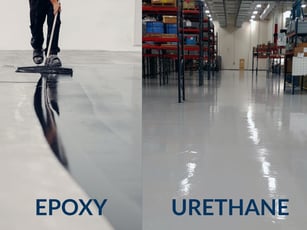
Both epoxy and urethane have unique properties that make each highly effective as a standalone industrial flooring solution. Yet, even though they are often paired, epoxy and urethane serve different purposes in a flooring system:
- Epoxy floor coatings are rigid, high-strength systems that bond tightly to concrete and withstand heavy loads and impacts.
- Urethane floor coatings are more flexible and perform better under abrasion, chemical exposure, and temperature changes.
What do Epoxy and Urethane Floor Coatings Accomplish Together?
Epoxy and urethane each perform well individually, but why not enjoy both worlds? When used in tandem on concrete floors, epoxy and urethane create a layered flooring system that balances strength and flexibility; a new level of performance that neither coating provides on its own. Epoxy provides a strong, impact-resistant base, while urethane adds abrasion resistance, chemical protection, and UV stability.
Key Benefits of Epoxy-Urethane Flooring Systems
- The floor will last longer than any other floor coating solution.
- You won't need to pay to replace your floor for at least another decade.
- The resale value of your industrial facility improves with the quality of your floor.
- The floor is resistant to damage from water, oil stains, abrasions, and impact.
- The floor is resistant to corrosion due to industrial chemicals.
The Drawbacks of Using Epoxy and Urethane Together
While epoxy-urethane systems are highly effective, they are not always the right solution.
Potential drawbacks include:
- Increased installation time compared to single-coat systems
- Higher upfront cost
- Greater importance of proper surface preparation
- Risk of failure if layers are applied in the wrong order
Correct Layering Order in Epoxy-Urethane Systems
As mentioned earlier, applying epoxy and urethane in the wrong sequence can significantly compromise system performance. Adhesion issues, premature wear, and coating failure often stem from improper layering or inadequate surface preparation. Understanding how these materials interact is essential to achieving long-term durability and protection.
Let’s clarify how these coatings should, and should not, be installed.
Can You Put Epoxy Over Urethane?
In most cases, epoxy should not be applied over urethane. Urethane’s flexibility and surface characteristics make it difficult for epoxy to bond properly, which can lead to adhesion failure.
Can You Put Polyurethane Over Epoxy?
Yes, urethane is commonly applied over epoxy, and this is, in fact, the preferred order in epoxy-urethane systems. The epoxy layer establishes a rigid, well-bonded foundation anchored to the concrete, and the urethane topcoat enhances surface durability and long-term environmental resistance.
How to Correctly Use Epoxy and Urethane Together?
- Prepare the concrete surface
The slab must be properly cleaned, repaired, and mechanically profiled to ensure adhesion. - Apply the epoxy base coat
Epoxy is installed as the primary structural layer and allowed to cure according to manufacturer’s specifications. - Inspect and prepare the epoxy surface
Light abrasion or sanding may be required to ensure proper bonding of the urethane layer. - Apply the urethane topcoat
Urethane is applied to enhance abrasion resistance, chemical protection, and flexibility. - Allow proper cure time before use
Full cure ensures the system performs as designed under traffic and exposure.
Epoxy and Urethane Combination – Do’s and Don’ts
|
Do |
Don’t |
|
Use epoxy as the base layer |
Mix epoxy and urethane into a single solution |
|
Allow proper cure times between layers |
Apply epoxy over urethane |
|
Prepare surfaces between coats |
Rush installation schedules |
|
Use urethane for abrasion and chemical resistance |
Skip surface profiling |
Real-World Results: Epoxy-Urethane Flooring in Action
The 1,930-square-foot Saluda Hydroelectric transformer containment area in Lexington County, SC, was experiencing ongoing water leaks from an elevated outdoor concrete slab. After inspecting the facility, we developed a plan to stop the leaks while also delivering a long-term solution.
After the surface was properly prepared, our team used flexible epoxy to repair cracks and restore the concrete's integrity. Then, since the containment area was outdoors, we applied a urethane topcoat to protect the system from UV damage and weather-related wear.
The result was a durable, watertight system designed to provide 12 to 18 years of long-term protection.
Final Thoughts on Epoxy-Urethane Floor Coatings
Epoxy-urethane systems can deliver exceptional performance, but only when they’re installed correctly. If you’re considering this combination for your facility, the key is choosing the right materials, preparing the slab properly, and applying each layer the way the system requires. Done right, you get a floor built to handle heavy traffic, harsh chemicals, and long-term wear.
If you’re evaluating epoxy, urethane, or combination floor coating systems, CPC Floor Coatings can help. Our team assesses your environment, traffic conditions, and performance needs to recommend a system built for long-term success. Contact us to discuss your project or request a professional evaluation.