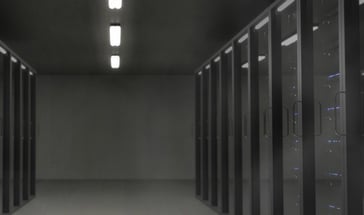
 We know how important environmental control is for data centers, from carefully regulated air temperatures and humidity levels to two-roof systems to prevent the possibility of leaks onto sensitive equipment. Whether you’re building a new facility or transforming an outdated data center to meet today’s standards, you’ll want to invest in flooring that helps control the environment and protects equipment.
If your facility has concrete flooring, installing an epoxy coating is an economical option that offers several major benefits.
What Are the Advantages of Epoxy Flooring for Data Centers?
Weight-Bearing Strength & Durability
An epoxy coating is created by combining a resin and a curative, forming a chemical bond that is stronger than the sum of its parts. This bond produces a high-strength, semi-flexible surface capable of supporting thousands of pounds of equipment without cracking, chipping, or degrading over time. In modern data centers, where floors must handle densely packed server racks, cooling systems, rolling lifts, and constant staff movement, epoxy coatings provide the durability needed to withstand ongoing traffic, equipment installation, and repositioning without compromising floor integrity.
Electrical Conductivity & ESD Control
Static electricity is a constant concern in data centers filled with sensitive servers and electronic equipment. Conductive epoxy floor coatings incorporate specialized fillers that provide a controlled pathway for static charges to dissipate safely to ground. By reducing static buildup from foot traffic and equipment movement, ESD-rated epoxy flooring helps protect critical hardware, minimize the risk of component damage, and support reliable, uninterrupted data center operations.
Environmental Stability & Thermal Support
Data center floors play a quiet but important role in maintaining stable operating conditions. Epoxy floor coatings seal the concrete slab, limiting moisture vapor transmission that can contribute to humidity swings or condensation near critical equipment. Also, when engineered with specialized fillers, epoxy floor coating promotes more efficient heat transfer across the floor surface. Together, these properties help support consistent temperatures, protect equipment, and reinforce the effectiveness of broader cooling and environmental control strategies.
Cleanliness & Simplified Maintenance
Air quality is critical in data centers, where airborne dust and moisture can interfere with equipment performance, cooling efficiency, and airflow. Epoxy floor coatings seal and smooth the concrete surface, blocking moisture vapor and eliminating cracks and joints where dust and debris typically accumulate. This helps reduce particulate buildup that can be pulled into servers or disrupt cooling systems.
The seamless, non-porous finish also makes routine cleaning faster and more effective. Spills can be wiped up easily, maintenance demands are minimized, and the controlled environment required for reliable data center operations is easier to maintain.
Sustainability & Resource Efficiency
Sustainability is becoming a critical consideration in data center design and operations, driven by energy-efficiency goals, regulatory pressure, and long-term cost control. Epoxy floor coatings contribute to sustainability by extending the life of concrete slabs, reducing the need for frequent repairs and replacements, and avoiding the use of material-intensive flooring systems. Their seamless, durable surface supports efficient cleaning with fewer chemicals and less water, while improved airflow control and reduced dust accumulation can help cooling systems operate more efficiently. Together, these benefits support a more resource-efficient facility with a lower operational footprint over time.
Aesthetics & Visual Organization
Epoxy floor coatings offer more than performance benefits; they also give data centers greater control over how their spaces look and function. Available in a wide range of colors, finishes, and decorative options, epoxy can be used to support visual organization through color-coded rooms, pathways, or access zones. These visual cues help reinforce workflow, safety, and cable management without relying solely on signage.
Decorative flake and metallic epoxy systems also provide a polished, modern appearance that’s well-suited for control rooms or client-facing areas, helping data centers present a clean, intentional, and high-tech environment while maintaining the seamless durability required for daily operations.
Epoxy Coatings vs. Raised Floors in Modern Data Centers
Raised flooring (also known as access flooring) was the standard in early data center designs, supporting underfloor cooling, cable routing, power distribution, and grounding. However, modern data center architecture has evolved significantly, combining more efficient cooling strategies and layout design with substantially heavier equipment, especially in AI-driven environments.
As a result, raised floors are used far less frequently today and, when implemented, are often modified for specific utility needs rather than full-room airflow. For many modern builds, epoxy-coated slab floors have emerged as a durable, cost-effective alternative that aligns better with modern cooling approaches and higher equipment loads.
Epoxy Coatings vs. Raised Floors: Side-by-Side Comparison
| Consideration | Raised Floors | Epoxy-Coated Floors |
| Weight Support | Load limits can be challenged by AI and high-density racks | Directly supports heavy equipment, including AI racks exceeding 4,000 lbs |
| Cooling & Airflow | Underfloor cooling can lose efficiency due to bypass airflow through gaps and penetrations | Seamless surface seals slab joints and gaps, reducing bypass airflow and improving cooling efficiency |
| Cost | Higher cost due to additional materials, structure, and installation | Typically lower cost by finishing the existing concrete slab |
| Installation Time | Longer build timelines and complex coordination can take 12–36 months from design to commissioning | Faster installation that can typically be completed in days |
| Flexibility | Changes to the layout can require tile reconfiguration and structural adjustments | Easy to reconfigure layouts without structural changes |
| Maintenance & Cleanliness | Underfloor spaces can trap dust and complicate cleaning | Seamless surface simplifies cleaning and supports air quality |
| Use in Modern Designs | Still used selectively, often at reduced heights for utilities | Increasingly common in modern, high-density, and AI-focused facilities |
Is Epoxy Flooring Right for Your Data Center?
Epoxy floor coatings offer a practical, future-ready solution for modern data centers, but performance depends heavily on proper design and installation. To avoid issues such as peeling, premature wear, or failures that could compromise strength, air quality, or cleanliness, it’s essential to work with an experienced epoxy flooring contractor.
If your data center is located in the greater Atlanta area, the Carolinas, eastern Tennessee, contact CPC Floor Coatings. Our team can evaluate your facility, recommend the right epoxy system for your operational needs, and provide a free, personalized estimate.